Rustic Billiards
  • Home
  • Reviews
  • Log Pool Tables
    • COLORADO
    • BEAR
    • COUNTRY
    • COWBOY
    • ​PONDEROSA
    • LODGE
    • ​OUTBACK
    • GUN SMOKE
  • Contact
  • About
    • Quality
  • Home
  • Reviews
  • Log Pool Tables
    • COLORADO
    • BEAR
    • COUNTRY
    • COWBOY
    • ​PONDEROSA
    • LODGE
    • ​OUTBACK
    • GUN SMOKE
  • Contact
  • About
    • Quality
Search

​The Rustic Billiards Journal

Cushion Failure in Rustic Installations: A Forensic Account of Rubber Degradation, Rail Separation, and the Tolerances Most Buyers Never Inspect

6/2/2026

 
Vulcanized gum rubber rated at 35–38 Shore A durometer does not fail catastrophically. It fails incrementally—hardening by single-digit durometer increments across seasonal humidity cycles until the rebound coefficient drops below the threshold where accumulated shot memory becomes worthless. By the time a player notices that a three-rail position has started dying on the second, the cushion profile has already been compromised for eighteen months.
This is the failure mode that no amount of visual inspection catches. The dovetail joints on the rail cap can be flawless. The bolt pattern anchoring the rail to the cabinet can be torqued to spec. The cushion nose, seated against a K-66 profile—that 1⅝-inch base width, angled at 66 degrees off the slate plane—can appear structurally intact on contact. The degradation is molecular before it is mechanical.
K-66 profile geometry places the cushion nose at a precise height relative to the ball's equator: on a table built for 2¼-inch American billiard balls, that nose sits at 1⅜ inches off the slate surface, directing rebound energy back through the center mass of the ball rather than skimming its crown or undercutting its belly. When the rubber loses elasticity and the nose begins to deform under sustained load, that contact point migrates. The angle the player read from the diamonds is no longer the angle the ball receives. The error is not in the stroke. It is in the material.
Antique log chassis construction compounds this problem in ways that flat-panel cabinet tables avoid entirely. Northern white oak or reclaimed pine framing—common in heritage rustic builds—responds to seasonal moisture variance with dimensional movement of 1–3mm across the rail bed width. A cross-bolted chassis absorbs most of this, but if the rubber-to-rail adhesion layer has softened, that micro-movement works the cushion base loose from the mounting surface. Dead spots that present as localized cushion failure are often rail-separation events detectable only by pressing the cushion face laterally and observing whether the base lifts from the staple line.
The rubber compound itself warrants forensic attention before any table purchase or restoration. Natural gum rubber holds elasticity longer than synthetic blends under high-humidity conditions—relevant in any installation where the room is not climate-controlled to below 55% relative humidity year-round. Synthetic compounds engineered for indoor environments rated at 45–50 Shore A can perform consistently in controlled settings but stiffen disproportionately when ambient temperature drops below 60°F, a condition common in the basement and outbuilding installations where rustic tables typically live. A cushion that played true at 68°F will return a measurably tighter angle at 58°F—not dramatically, but enough to invalidate a player's calibrated bank shot system by 2–4 degrees off the long rail.
Three-piece diamond-honed slate beds, standard in tables built above the $3,000 threshold, introduce a secondary tolerance variable at the seam lines. Slate calibrated to within 0.01mm across the playing surface can still produce micro-ridges at the three-section joints if the cushion rubber's shore hardness causes the ball to deflect slightly on impact near rail proximity. Tournament installations spec the slate-to-cushion interface with this in mind—the rail overhang above the slate face is held to within 1/32 inch of the cushion nose height to prevent ball hop on near-rail shots. On rustic builds where the rail cap is hand-fitted to a log or rough-hewn hardwood sub-frame, this tolerance requires individual verification at installation rather than reliance on factory-cut standardization.
Cushion cloth backing—the woven layer bonded to the rubber's base—is the component most frequently ignored in table assessments and most often responsible for premature separation in humid environments. A backing rated for 80% wool, 20% nylon blend resists moisture absorption and maintains bond integrity to the rail stapling surface across a wider humidity range than synthetic-dominant backing cloths. When the backing saturates, the adhesive layer between rubber and mounting rail softens, and the cushion begins to migrate forward under repeated ball impact, reducing the effective nose height below the designed equatorial contact point.
The Rustic Billiards Journal of Timber Engineering represents an analytical synthesis of heritage craftsmanship and structural materials science. Formulated exclusively for estate managers, timber architects, and private collectors.

The Clearance Problem Nobody Measures Before Writing the Check

5/28/2026

 
A standard 58-inch cue requires approximately 60 inches of rear clearance on every shot—meaning the butt of the stick needs five full feet of unobstructed space behind the cue ball before the stroke even begins. On a 9-foot table installed in a 14×17-foot room, that clearance vanishes on two ends and both rails simultaneously. The table fits. The game doesn't.
This is the failure mode that defines most bad billiard room installations. Not the table selection—the room selection. Or more precisely, the decision to treat the table's footprint as the only spatial variable worth measuring.
Residential pool tables ship in four common playing-surface sizes: 7-foot (39" × 78"), 8-foot (44" × 88"), 8.5-foot (44" × 92"), and 9-foot (50" × 100"). Those are the playing field dimensions. The cabinet frame adds several inches per side depending on manufacturer rail construction—typically 4 to 6 inches per long rail and 4 to 5 inches per short rail on production tables.
The number that governs whether the room functions is the minimum cue clearance buffer: at least 58 inches from each playing surface edge to the nearest wall, column, built-in, or fixed furniture piece. Installation guidelines push that figure to 60 inches to accommodate bridge shots and mechanical rest strokes without forced body contortion—a compensation that begins affecting positional accuracy the moment a player shortens their bridge arm to avoid contact with a wall.
Applying that math to a 7-foot table, a playing surface of 78 inches long by 39 inches wide requires an absolute minimum room length of 198 inches (16.5 feet) and a minimum width of 159 inches (13.25 feet). A 9-foot table in the same clearance model demands a room of at least 18.3 feet × 18.1 feet—before accounting for spectator circulation, cue rack placement, or fixed architectural elements. No quality of three-piece diamond-honed slate compensates for a room that compresses the stroke before the tip contacts the cue ball.
Ceiling height generates a secondary clearance failure that floor plans never capture. Low-beam ceilings, dropped soffit installations, and exposed structural timber—common in log and reclaimed-frame interiors—interfere with elevated bridge shots, mechanical rest use, and the overhead stance on cross-table strokes. The operational floor is 78 inches from finished floor to the lowest overhead obstruction; the workable standard is 84 inches. Below 72 inches, players begin generating forced technique adjustments on any shot requiring an elevated cue angle, which includes most cross-table positions on a 9-foot bed.
Lighting placement interacts directly with that clearance band. A billiard light bar positioned for glare-free ball tracking hangs 32 to 36 inches above the playing surface. In a room with a ceiling height under 8.5 feet, that fixture drops into the cue swing path of any player executing an elevated bridge. The fixture doesn't move. The player absorbs the constraint through stroke compromise.
A 7-foot table in a room with full clearance plays better than a 9-foot table in a room that is two feet short on both ends. Forced stance adjustments on short-rail shots alter cue ball speed control, english application, and positional accuracy in ways that compound across a rack. The effect isn't dramatic on any single shot—it accumulates through the session as players unconsciously abbreviate their stroke to avoid contact with fixed surfaces.
Bar-box tables (7-foot) demand tighter positional thinking precisely because the table is smaller. The game they produce isn't a reduced version of 9-foot play—it's a different tactical set with its own positional logic. Many experienced players run 7-foot tables by deliberate choice when the alternative is a 9-foot installation with compromised clearance on two rails.
Eight-foot tables carry the widest range of residential room compatibility. At 44 inches wide, they require less cross-rail clearance than the 9-foot's 50-inch width, making them operable in rooms where the 9-foot triggers clearance failures on the short dimension. The 6-inch width difference translates to a full foot of recovered room space across both short-rail buffers.
Standard clearance calculations assume rectangular rooms with flush walls. Most architecturally layered interiors don't qualify. Structural columns placed inside the clearance buffer require position-specific adjustments affecting every shot originating from that quadrant. Recessed wet bars or built-in cabinetry along a long wall reduce effective clearance even when the nominal room dimension appears adequate on a floor plan.
Staircase landings or partial walls create asymmetric clearance—full depth on three sides, critically short on one—permanently eliminating a third of standard shot positions. Fireplace hearth protrusions extending 18 to 24 inches from a wall consume clearance from one short rail entirely, converting every short-rail approach shot into a forced bridge modification.
The correct measurement process runs from the innermost fixed obstruction outward, not from wall to wall. A tape measure stretched across open floor between two structural columns—with cabinetry on one side—is measuring the wrong geometry.
A billiard room that functions exclusively as a billiard room is a different design problem than one expected to carry bar seating, conversation areas, or multi-function game use. The clearance buffer around the table cannot double as circulation space—those square footages are spent the moment a table is installed at minimum clearance. Seating placed within the clearance zone forces a recurring conflict: spectators either relocate every time a shot approaches their position or absorb interference into the game rhythm. Fixed high-top seating or banquette placement along a wall requires that wall to sit beyond the minimum buffer distance from the nearest table rail—not adjacent to it.
A 14×20-foot room accommodates an 8-foot table with standard clearance and approximately 36 inches of depth behind one long rail. That is enough for a fixed row of bar stools if the opposite long rail clearance holds full dimension. It is not enough for a banquette, a cue rack, and a circulation path simultaneously.
Table SizePlaying SurfaceMin. Room (58" Clearance)Min. Room (60" Clearance)7-Foot78" × 39"16'2" × 13'3"16'6" × 13'6"
8-Foot88" × 44"17'0" × 13'8"17'4" × 14'0"
8.5-Foot92" × 44"17'4" × 13'8"17'8" × 14'0"
9-Foot100" × 50"18'0" × 14'2"18'4" × 14'6"Cabinet frame dimensions vary by manufacturer. The full table unit must be measured, not merely the playing surface, when validating room fit. Clearance metrics detailed above calculate from the playing surface edge; installers must account for individual rail overhang dimensions when translating these figures to absolute wall-to-wall boundaries.
The Rustic Billiards Journal of Timber Engineering represents an analytical synthesis of heritage craftsmanship and structural materials science. Formulated exclusively for estate managers, timber architects, and private collectors.

The Surface Isn't Felt. It Never Was.

5/24/2026

 
Three years into operation, a table that looked impeccable at installation starts producing lateral drift on center-ball shots—not from cloth wear, not from rail cushion compression, but from a ¾-inch MDF sub-bed that absorbed ambient moisture and introduced a 0.4mm crown across the longitudinal axis. The felt masked it. The finish still gleamed. The slate was never there to begin with.
This is the failure that separates a playing table from furniture that holds pool equipment.
Slate enters billiard construction because no engineered wood product, no synthetic composite, and no poured concrete alternative has matched its combination of natural grain density, near-zero thermal expansion, and machinability to sub-millimeter flatness tolerances. The stone is typically honed to within 0.2mm across the playing field—a calibration that determines whether a ball rolling 8 feet across the surface loses less than a ball-diameter of directional error or begins drifting before it reaches the far cushion.
Tournament-grade tables above 8 feet use three-piece slate for a structural reason that has nothing to do with cost. A single slab spanning the full length of a 9-foot or 10-foot table introduces unacceptable flex risk during transport and installation. Sectional construction allows each piece to be independently shimmed during installation, which means an installer can correct for subfloor irregularity at the joint level rather than compensating across the full span. The seams are filled and honed flat post-installation, producing a continuous surface whose joints are undetectable under cloth.
Conversely, one-piece slate on tables under 7 feet avoids the seam variable entirely, which is appropriate at that scale—but the moment the playing field extends beyond what a single slab can handle without stress loading, sectional construction produces superior long-term alignment.
This sectional stability directly connects to slate thickness, which in professional tables runs from ¾ inch at entry-grade to 1 inch and above on tournament installations. The additional mass—a primary reason finished professional tables exceed 900 to 1,200 pounds—is not incidental. Thicker slate resists the micro-deflection that occurs when a 6-ounce ball is struck at break velocity. It also dampens the resonance transmitted upward through the cabinet frame when floor vibration, foot traffic, or mechanical systems in the building create low-frequency cycles that a thinner slab would transmit directly into the playing surface.
Yet a three-piece, diamond-honed slate assembly calibrated at the mill will perform at specification only if the cabinet beneath it was built to hold it without flex. Cross-bolted frame construction matters here—the mounting surface must not rack under load. After the slate is set and shimmed level, the seams are filled with beeswax or an equivalent material that bonds without creating a ridge, and the cloth is stretched under even tension across the full surface.
Rail cushions—typically profiled to K-66 or K-55 specification in American-style tables—must be mounted at a height that positions the contact point at the centerline of the ball, typically 63.5% of ball diameter above the playing surface. Off-spec rail height changes the rebound angle independent of anything the slate itself is doing. A rushed installation on a correct slate assembly produces the same ball-roll inconsistency as a correct installation on a compromised surface. Both variables require absolute specification.
The Rustic Billiards Journal of Timber Engineering represents an analytical synthesis of heritage craftsmanship and structural materials science. Formulated exclusively for estate managers, timber architects, and private collectors.

Why Reclaimed Wood and Slate Define the Rustic Billiards Room

5/23/2026

 
Reclaimed timber's moisture content, if not stabilized below 9% before cabinet assembly, transfers dimensional stress directly into the slate bed. A three-piece slate assembly diamond-honed to within 0.1mm across all seam joints cannot hold that tolerance when the surrounding chassis is still cycling through seasonal wood movement. The slate does not fail visibly — it drifts. Ball roll deviation begins accumulating in fractions, detectable only by a precision spirit level or a consistent break pattern that no longer reads true off the foot rail.
This is the structural argument for reclaimed wood done correctly, not reclaimed wood as an aesthetic category.
Northern antler-cut white oak and Douglas fir retrieved from pre-1950 barn and industrial framing stock typically carry tighter grain rings than contemporary kiln-dried lumber — 12 to 18 annual rings per inch versus 4 to 7 in modern plantation growth. Tighter grain translates directly into lower shrinkage coefficients across both radial and tangential planes. A reclaimed white oak cross-member running beneath a 4.5-inch slate bed will move less across a 40-point humidity swing than a comparable piece of modern poplar or pine. That mechanical stability is why reclaimed stock, sourced and dried properly, outperforms the sentimental reputation it usually gets credit for.
The joinery method amplifies or undermines that advantage. Mortise-and-tenon leg-to-rail connections, when cut to a 1:4 to 1:5 depth-to-width ratio and drawbored with a hardwood peg offset by 1.5mm to pull the joint mechanically tight on assembly, resist racking forces that pocket bolts cannot. A cabinet assembled with pocket screws into a reclaimed timber frame will begin showing micro-movement at the corner connections within three to five years of floor-level humidity cycling. The playfield reads that movement as a slow slope.
Slate sourced from Brazilian or Italian quarries and calibrated to a consistent 3/4-inch or 1-inch slab thickness still requires a substrate frame with zero tolerance for deflection. The K-66 cushion rail profile — a 66-degree nose angle with a specific 1-3/16-inch cushion height measured from the playing surface to the top of the nose — only performs within specification when the rail mounting surface is level and rigid. A frame that shifts seasonally throws the cushion nose geometry out of alignment with the center line of a standard 2.25-inch billiard ball. The contact geometry changes. Rail response becomes inconsistent without any visible surface defect to diagnose.
Cloth selection in a reclaimed-wood installation carries a separate variable. A 21- to 23-ounce worsted wool cloth, woven with no nylon filler content, has a pile direction that requires consistent backing rigidity. If the slate below flexes even fractionally at the center seam — a common result of insufficient shimming or a warped center support beam — the cloth surface develops a subtle crown. That crown does not appear in casual inspection. It appears in a cue ball that consistently drifts toward the center of the table on long rolls.
The iron hardware typical of rustic billiard cabinet design — cast legs, strap brackets, rail caps — introduces thermal mass the wood alone does not carry. In rooms with radiant floor heating or significant south-facing sun exposure, iron components heat and expand at a rate approximately eleven times higher than the surrounding timber. Fasteners connecting iron leg plates to wood aprons work against each other across temperature cycles, gradually loosening unless originally set with expanding anchor inserts or installed into a threaded hardwood block rather than directly into end grain.
End-grain fastening in billiard cabinet construction pulls out at roughly one-third the load capacity of long-grain fastening. That figure matters in any table where leg levelers bear point loads across an uneven stone or wide-plank hardwood floor.

The Rustic Billiards Journal of Timber Engineering represents an analytical synthesis of heritage craftsmanship and structural materials science. Formulated exclusively for estate managers, timber architects, and private collectors.

Rustic Billiards Rooms That Feel Lived In, Warm, and Built to Gather

5/21/2026

 
Kiln-dried white oak behaves differently than green-cut timber under a billiard cabinet—seasonal expansion across the grain can run 3 to 5 percent in uncontrolled interior humidity, enough to torque a leg assembly and introduce measurable pitch variance across the slate bed. That is the first engineering reality rustic game room design must answer before any conversation about atmosphere begins.
Architectural installations within high-volume timber lodges, subterranean ranch wings, and mountain retreats fail when material selection ignores structural load dynamics. The permanence of a space relies on how its components absorb kinetic and thermal stress over time. A cross-bolted northern antique log chassis resists lateral cabinet shifting during high-velocity break shots in ways that standard composite core materials cannot. Similarly, a three-piece diamond-honed slate bed, precisely shimmed to within fractions of a millimeter, maintains playing-field equilibrium even when positioned adjacent to a massive masonry fireplace generating continuous radiant heat.
Reclaimed wide-plank flooring—specifically 5-inch to 8-inch face widths in white oak or Douglas fir—governs the room's acoustic profile. Standard narrow-strip hardwood or polished concrete slabs function as hard acoustic mirrors, reflecting high-frequency cue-strike sound back into the vaulted ceiling path. In contrast, wide planks with retained hand-scraped or wire-brushed surface textures function as geometric diffusers, scattering mid-frequency sound waves and lowering the overall reverberation time. This physical absorption coefficient is the exact mechanical reason a space registers as quiet and contained, rather than an arbitrary design choice.
The pool table's position as the primary high-mass element dictates the surrounding traffic clearance, sightlines, and lighting geometry. A standard North American 9-foot table demands a 19-by-14-foot open floor plan layout to preserve a minimum 5-foot cue clearance buffer from the playing surface edge to the nearest structural wall or architectural pillar.
Exposed ceiling beams, when aligned parallel to the table's longitudinal axis and kept clear of the 60-inch centered illumination zone, provide clean visual framing without disrupting cue movement. Focused illumination is best delivered via iron pendant fixtures or aged-brass linear rails suspended 32 to 36 inches above the cloth bed, delivering flat, shadowless light at a color temperature between 2700K and 3000K to prevent visual distortion during thin cut shots along the rail cushions.
Spectator seating configurations placed 8 to 12 feet from the long rail insulate the playing area from human movement while preserving stroke clearance. Full-grain aniline leather, which avoids the chemical leveling treatments of corrected-grain or bonded alternatives, dynamically responds to seating compression and natural skin oils over an 18-to-24-month operational window. This process represents a structural material reaching its stable, work-hardened use state. Synthetic upholstery materials lack this cell elasticity, remaining structurally stagnant before experiencing catastrophic surface cracking along tension folds.
Modern rustic interiors pair wire-brushed oak cabinetry with low-reflectivity matte black steel hardware because both surfaces minimize specular reflection under intense directional lighting. High-gloss wood finishes paired with polished chrome rails generate harsh hotspots that interfere with sightlines across the table.
Felt color choices follow the same rule of contextual stability; deep charcoal, warm grey, hunter green, and natural slate tones integrate cleanly within timber-dominated palettes, whereas commercial tournament blue or electric green isolates the table visually from the architecture, breaking the cohesive flow of the room.
The spaces that maintain functional longevity are those where surface finishes do not require active environmental protection. A distressed, oil-rubbed timber rail encapsulates physical wear directly into its grain structure without undermining its structural integrity. A worn leather armrest on a custom scoring credenza communicates structural utility through use.
When a billiards space is engineered with high-durability, pre-weathered materials, user caution drops, and operational activity increases. True environmental utility begins when the user stops treating the furniture as a delicate artifact and begins interacting with it as heavy machinery.
Integrating a massive stone fireplace adjacent to the playing area introduces a specific thermal constraint that must be managed: sustained ambient temperatures exceeding 80°F on the nearest rail accelerate the vulcanization process of K-66 rubber cushion profiles, dropping the rebound elasticity coefficient. Annual cushion diagnostics utilizing a durometer to check for localized hardening above a 75 Shore A rating should be standard preventive maintenance on any table where the chassis sits within 6 feet of a shared radiant heat source.
The Rustic Billiards Journal of Timber Engineering represents an analytical synthesis of heritage craftsmanship and structural materials science. Formulated exclusively for estate managers, timber architects, and private collectors.

Solid Grain Never Lies: What a Rustic Pool Table's Construction Reveals Before the Break

4/20/2019

 
​Particleboard cores fail along glue lines, not wood fibers. That distinction matters the moment a three-piece slate bed—diamond-honed to within 0.05mm flatness tolerance—transfers its combined mass load into a cabinet that was never engineered to receive it. The rustic billiard table occupies a peculiar position in furniture construction: its aesthetic vocabulary of exposed knots, hand-hewn textures, and distressed surfaces is not decorative license. It is the visual record of a hardwood that was allowed to season properly, stress-relieve across its grain, and arrive at dimensional stability before any joinery was cut.
Northern white oak and reclaimed Douglas fir—the species most commonly specified in heritage rustic builds—carry Janka hardness ratings between 1,290 and 1,650 lbf. At those densities, the cabinet resists the micro-racking that occurs when players lean into rail shots at oblique angles. A mass-produced table with MDF side rails will begin showing corner separation within eighteen months of active play. The same force applied to a cross-bolted antique log chassis distributes laterally through the grain rather than concentrating at fastener points.
The room temperature argument for rustic construction is not aesthetic. Wood species with open cellular structures—the same structures that produce visible grain patterns and natural luster under light—respond to ambient humidity changes by expanding and contracting across the width of the board, not along its length. A cabinet built from properly quartersawn hardwood panels controls that movement directionally. The slate bed stays level. On tangentially sawn softwood frames, seasonal humidity swings of 20% RH or more introduce cumulative warp that degrades the cushion rail geometry over time, pulling K-66 profile rubber away from its seating line and introducing throw error at rail contact.
Hand-forged metal hardware—leg bolts, corner brackets, and rail anchor plates—carries a functional specification advantage beyond its visual weight. Cast iron and hot-rolled steel components used in quality rustic builds have material thicknesses that prevent the fastener creep common in zinc die-cast hardware. Under repeated impact vibration from break shots averaging 25–30 mph cue ball velocity, lightweight hardware loosens incrementally. The visual heaviness of blackened iron hardware on a rustic frame is the mechanical consequence of specifying components that hold torque retention under long-term dynamic load.
The premise that rustic tables occupy only cabin interiors or hunting lodge game rooms does not survive contact with structural reality. Any architectural space that incorporates exposed timber ceiling members, stone cladding, or concrete aggregate flooring creates a thermal mass environment where synthetic laminates age poorly and natural materials stabilize.
Interior designers introducing rustic billiard furniture into contemporary open-plan spaces, industrial lofts, or transitional environments are not making a stylistic compromise—they are correcting a thermal and acoustic problem that flat, high-gloss surfaces accelerate. Natural wood absorbs and scatters mid-frequency soundwaves rather than reflecting them back across a hard room, lowering the overall reverberation time during high-occupancy use.
Wear behavior on a rustic table confirms the engineering logic over time. Distressed finishes and hand-applied stains are not camouflage—they are base coats applied over wood that already carries surface variation from the milling process. A contact scuff or edge mark on a factory-lacquered veneer table reads as damage. The same contact on an oil-rubbed hardwood frame reads as a continuation of the surface narrative already established by the original finish. The wood ages into its use rather than away from it, allowing the frame to work-harden under regular physical impact without showing structural or cosmetic degradation.
Cloth specification on rustic-category tables follows the same reasoning. A 21-oz to 24-oz worsted wool-nylon blend at an 80/20 ratio provides the roll speed and surface consistency that heavier napped cloth cannot maintain under regular play. Napped cloth on a cabinet that experiences seasonal movement becomes directionally inconsistent as the frame shifts, resulting in unpredictable ball-drift over long distances. Worsted cloth on a stable hardwood frame holds its tension uniformly across the playing surface and requires less frequent re-stretching following the initial break-in period.
The playing surface becomes unreliable when any single component in the mechanical chain—slate calibration, cabinet stability, rail rubber durometer, cloth tension—deviates from specification. Rustic construction, when executed from properly seasoned hardwood with heavy-gauge hardware and professional slate installation, eliminates the cabinet as the variable in that chain entirely.
The Rustic Billiards Journal of Timber Engineering represents an analytical synthesis of heritage craftsmanship and structural materials science. Formulated exclusively for estate managers, timber architects, and private collectors.
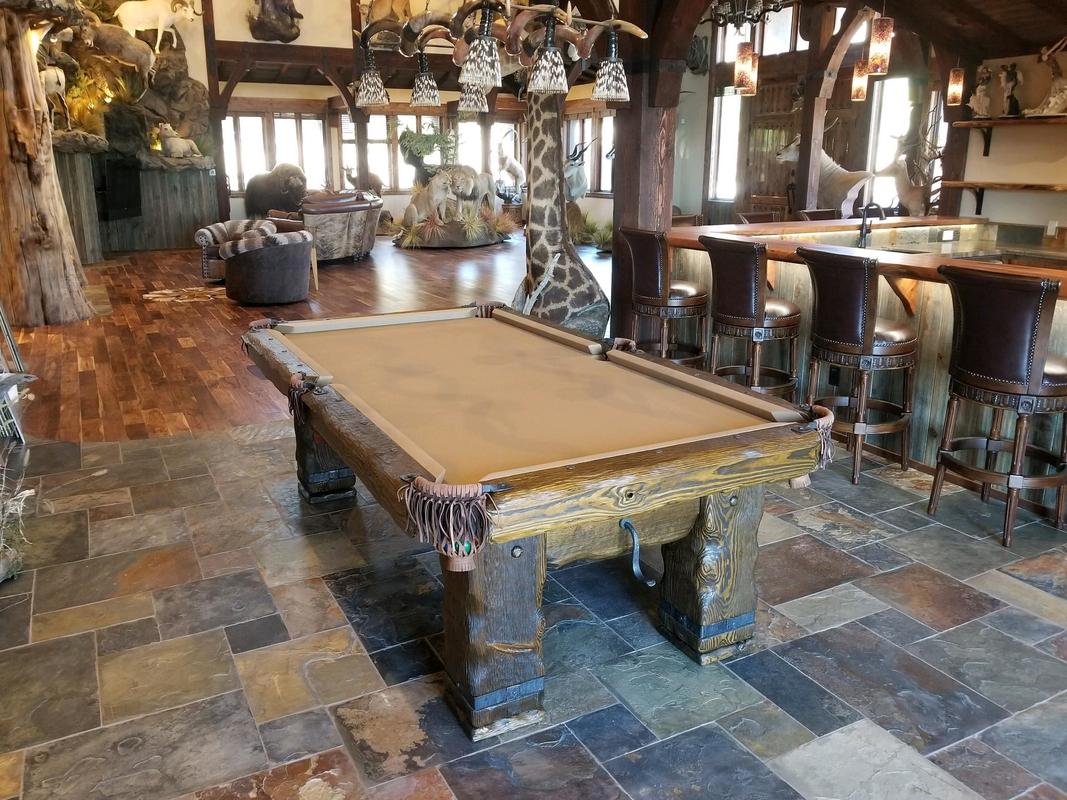
This rustic pool table is right at home in this Arizona trophy room.  The owners of this table were fantastic to talk with and we loved helping them get this all set up in a timely fashion.  The color of felt chosen looks perfect in this room.

This is what the customer of the photo just below had to say.:
"Looks good and plays great.  I liked the way this table leveled."  William in AZ
Log Pool Tables
Log Pool Tables

Ranch Log Pool Table

Wow the woods of the table match so well to the woods of the room. The perfect color of stain. Spectacular Log Pool Table in a hidden mountain estate.  Tournament blue felt is really a beautiful color and brings out some of the stones that are close to that color in the fireplace.  
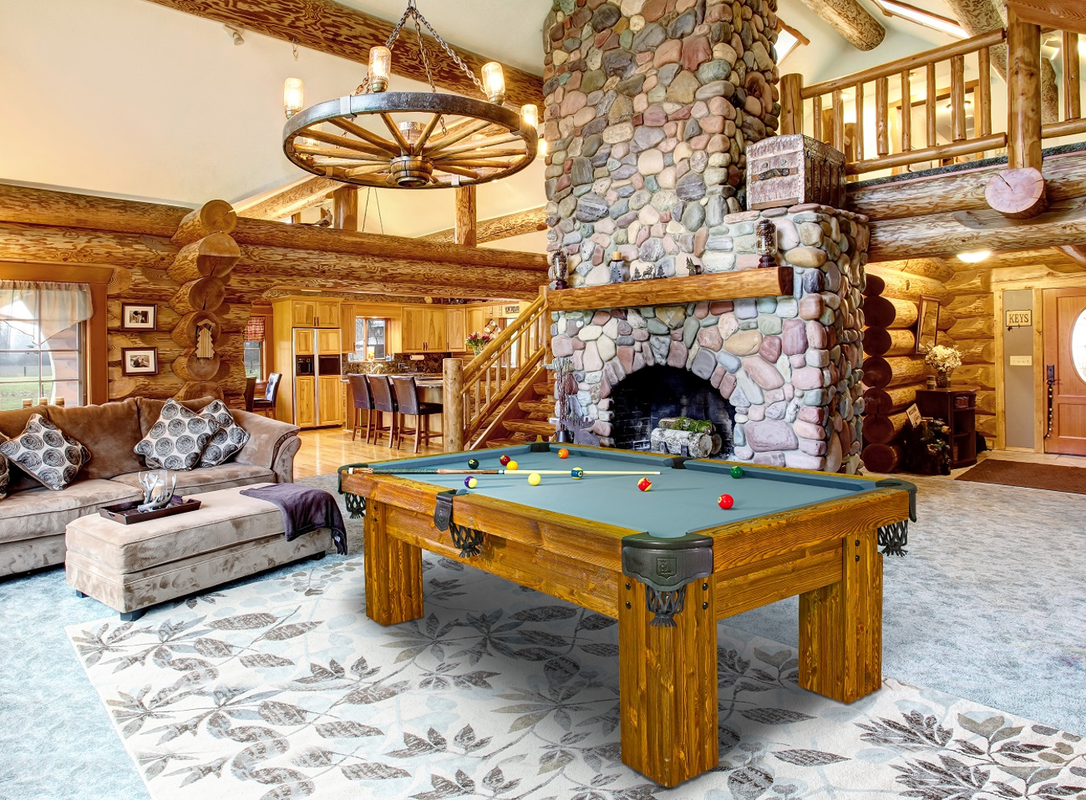
Log Pool Table in Hidden Mountain Estate

Barnwood Rustic Pool Table Video Testimonial
​Thank you Scott for the fantastic videos and pictures of your Barnwood Pool Table and game room.  You were a lot of fun to talk with.  It was our pleasure to serve you Sir my friend! 
​"My new Barnwood table was installed today by a professional installer who's been doing this for 30 years. He said it's been a long time since he installed a table of this quality. I was obviously happy to hear this comment from a completely objective person, and someone I consider an expert. The table looks amazing and I'm sure we'll get decades of enjoyment from it. You've been amazing to work with on the customer service. All of the delivery went just as planned, no damage, and everything fit together perfectly. I hope I have the opportunity to send some people your way in the future. Thanks for your great service and extremely high-quality product. We couldn't be happier!"
Scott in Tennessee

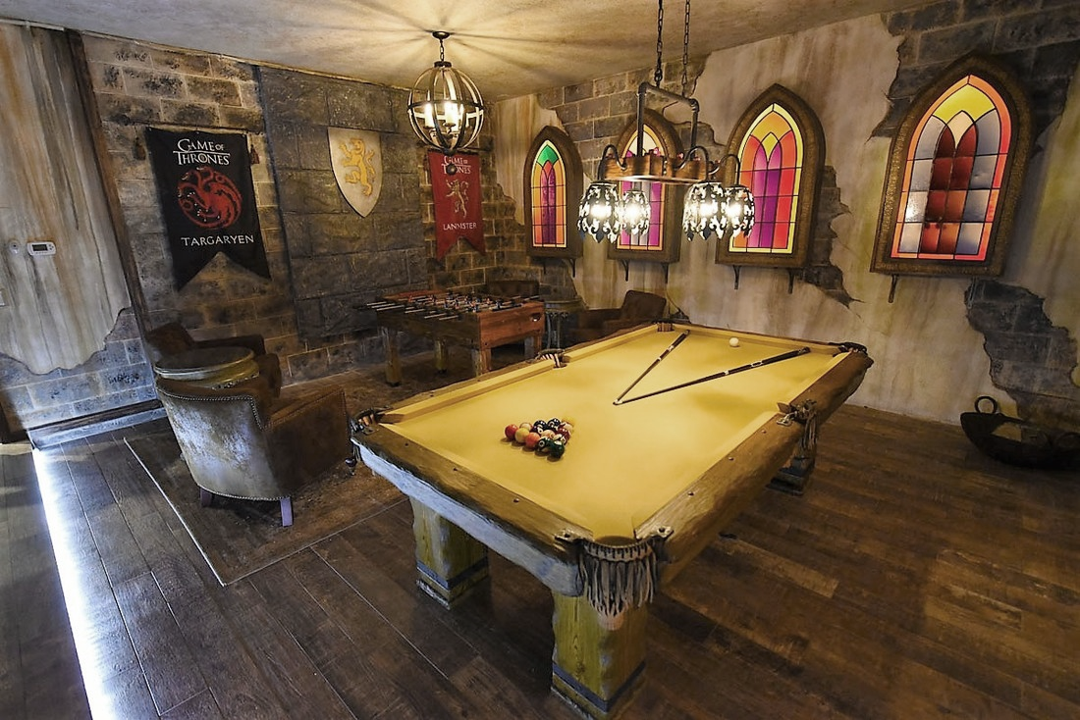
Grizzly Bear Rustic Pool Table

​A man cave fit for a caveman....or king...this is.. The hardest part of this process was the remote access to this stunning home.  The kahki felt was the perfect choice to bring out the colors of that in the room.  
Picture

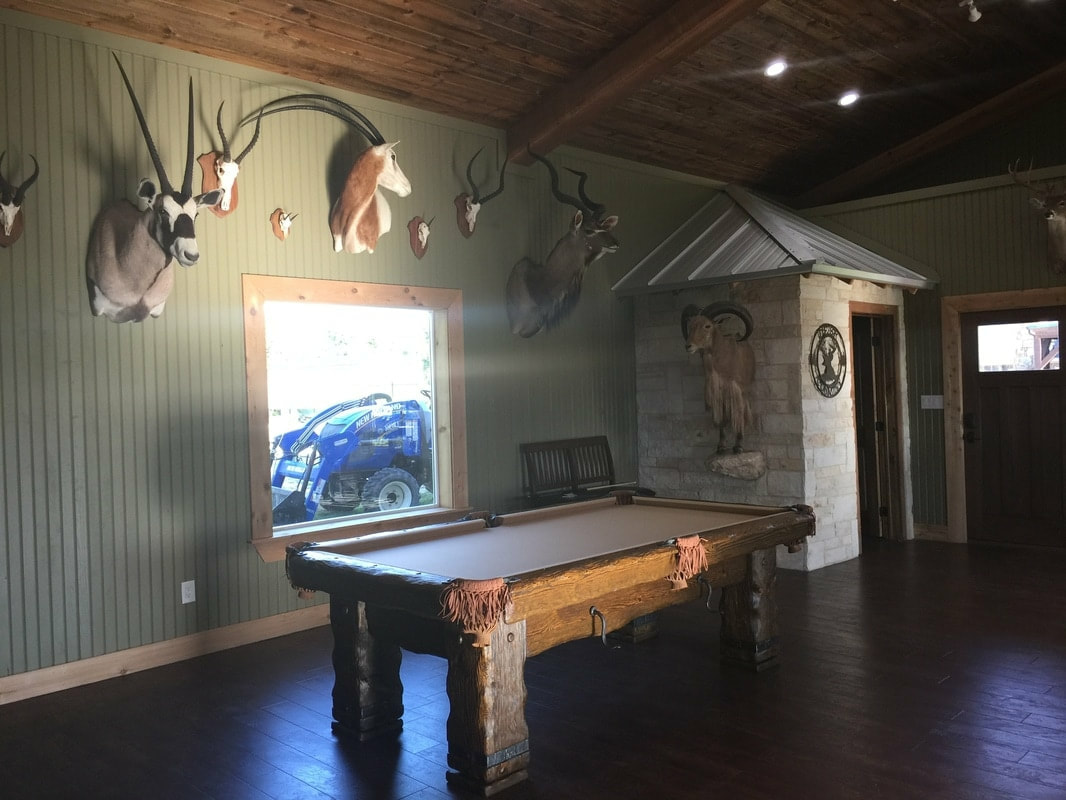
Rustic Pool Table in TX

Bright and open billiards room in Texas.  This pool table is just a gorgeous compliment to this rugged and touch game room in the heart of TX.  The came felt was the finishing touch.
Picture

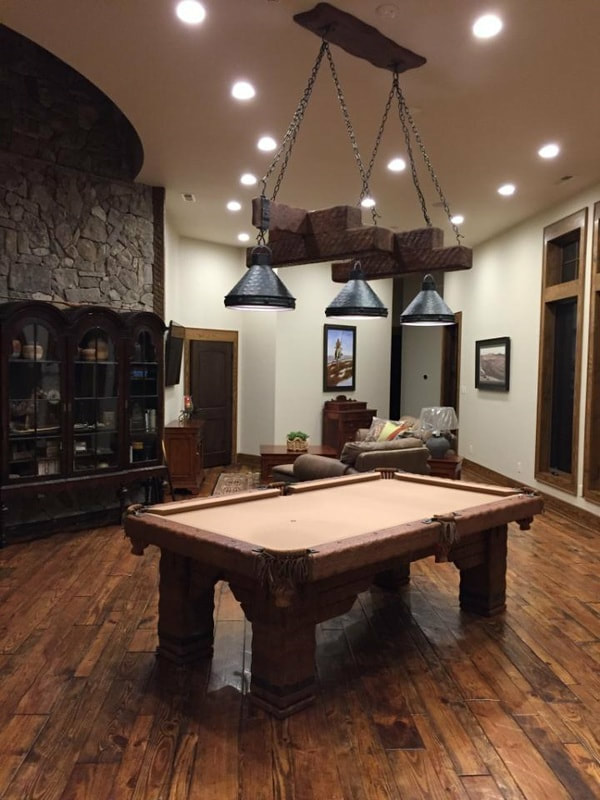
Gun smoke rustic pool table in Alabama.  This table set up went fantastic and it was such a pleasure serving these fine folks in AL.  This really is a wonderful room and the pool table was a dynamic addition.  A sandy brown cloth color looks stunning and will give years if not decades of play time... of course the table will last for many generations and be a treasured family heir loom that the entire gang will cherish.
Picture

Picture
"What a fantastic additional to our vacation home.  Family and friends have loved it and it's the hit of many of our parties. The folks at Generation Rustic Billiards were great to work with and they got all the little details perfect!"
​
  Jim B. ​California      

Barnwood pool table in Tennessee with Olive Felt.
Picture
Picture
​LUMBERJACK Log Cabin Pool Table in Colorado.

Gunsmoke Rustic Pool Table in MS

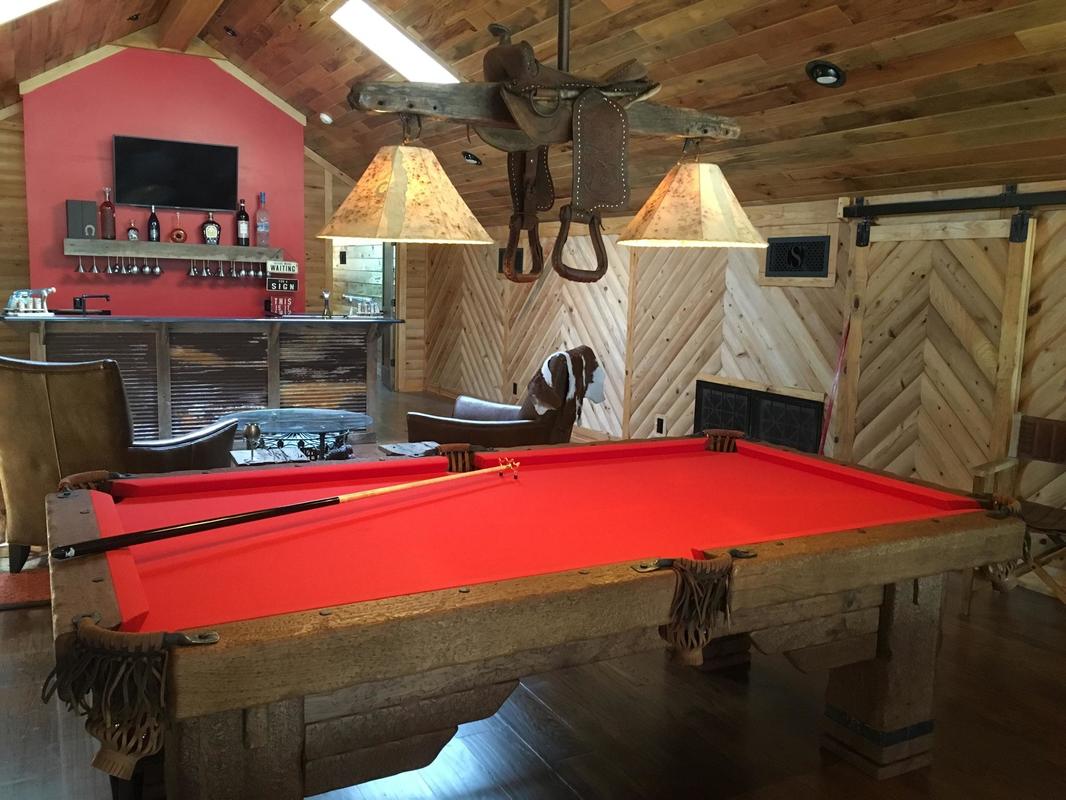
This was our first table sold in Mississippi and the table and room look amazing. The rich woods that make this room are the perfect compliment for the gun smoke table.  Firebrick felt pops and draws the eyes to the table and looks great with the accent wall. The light by the client was the perfect touch to finish the room,
Picture
​"Everyone Loves the Table."  Shelly in MS            Gun Smoke with Firebrick Red Felt in Mississippi

    Author

    Brian Maier

    Archives

    June 2026
    May 2026
    April 2019

    Categories

    All
    Billiard Guides
    Game Room Design
    Pool Table Buying Guide
    Pool Table Construction
    Rustic Billiards Design

    RSS Feed

Home
About us
Gallery
Options
Details
Testimonials
Blog
Contact us
  • Home
  • Reviews
  • Log Pool Tables
    • COLORADO
    • BEAR
    • COUNTRY
    • COWBOY
    • ​PONDEROSA
    • LODGE
    • ​OUTBACK
    • GUN SMOKE
  • Contact
  • About
    • Quality